
Products
Recommend Products
Contact Us
| Email: | info@sanchangpump.net |
| Hotline: | +86 181 4266 2779 |
| +86 193 1300 1794 | |
|
Wechat: |
+86 181 4266 2779 |
|
WhatsApp: |
+86 181 4266 2779 |
| Address: | No.517,Xiangfu Road |
| Yuhua District, | |
| Changsha City | |
| Hunan Province, P.R.C |

Single-stage Double-suction Split Case Pump
Classification:
Split Case Centrifugal Pump
Urban Water Supply
Salt Chemical
Key words:
Double-suction Split-case Pump
Centrifugal Pump
Water Pump
Single-stage Pump


Hotline:
- Product Description
- Performance Parameters
- Installation Drawings
- Installation and Operation
- Faults and Solutions
-
- Commodity name: Single-stage Double-suction Split Case Pump
Flow Range: 90~6300 m3/h</br> Head Range: 9.5~305 m</br> Fluid Temperature: 0 ℃ ~ 80 ℃</br> Inlet Pressure: 0.6 MPa</br> Shaft Seal: packing seal, mechanical seal</br> Available Materials: HT200, HT250, QT600, ZG, 304, 316, 316L, 317L, 904L, CD4-MCu, etc</br></br></br>
This pump fits media with temperature from -20℃ to 80℃.It transports industrial water, domestic water and tap water.It also works for water conservancy projects and farmland irrigation & drainage.
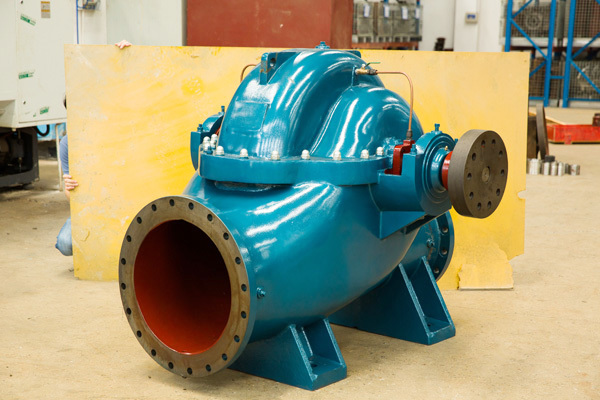
The SAP pump is newly optimized and upgraded.It inherits advanced technical advantages of traditional SA series pumps.
Common application scenarios:
- Urban water supply & drainage intake and pressurization
- Power plant water circulation
- Industrial process water systems
- Farmland irrigation and drainage
- Water conservancy engineering
- Petrochemical projects
I. Structure Description
1. SAP Horizontal Model
The SAP pump adopts horizontal installation.Suction and discharge nozzles sit below the pump shaft centerline.
The pump casing is horizontally split.Users do not need to disconnect pipelines for maintenance.
2. SLA Vertical Model (Same Series)
The SLA model is vertically installed.Its suction and discharge nozzles are arranged horizontally.
The split seam of casing and pump cover is perpendicular to the shaft centerline.
3. Bearing Configuration
Rolling bearings are installed on both ends to support the rotor.Two lubrication options: oil bath lubrication, grease lubrication.
4. Shaft Seal Options:
Soft packing seal; Mechanical seal
5. Double-suction Wear Ring
This part cuts liquid backflow from pressure chamber to suction chamber.
II. Rotation Direction
Viewed from the motor end, the pump rotates counterclockwise. Clockwise rotation is also available upon customer request.
III. Application
Applicable Scenarios
Factories, urban water systems, mines, power plants, farmland and water conservancy projects.
Transportable Media
Clean water without solid particles, and other liquids with similar physical & chemical properties to water.
IV. Model Description
Example: 10 SAP-6A
- 10 —— The value of pump inlet diameter divided by 25 (i.e. inlet diameter: 250 mm)
- SAP —— Improved version of SA type pump
- 6 —— Rounded value of specific speed divided by 10 (unit: m)
- A —— Modified outer diameter of impeller
-
Flow Range: 90~6300 m3/h
Head Range: 9.5~305 m
Fluid Temperature: 0 ℃ ~ 80 ℃
Inlet Pressure: 0.6 MPa
Shaft Seal: packing seal, mechanical seal
Available Materials: HT200, HT250, QT600, ZG, 304, 316, 316L, 317L, 904L, CD4-MCu, etc
-
-
Pump Assembly & Disassembly
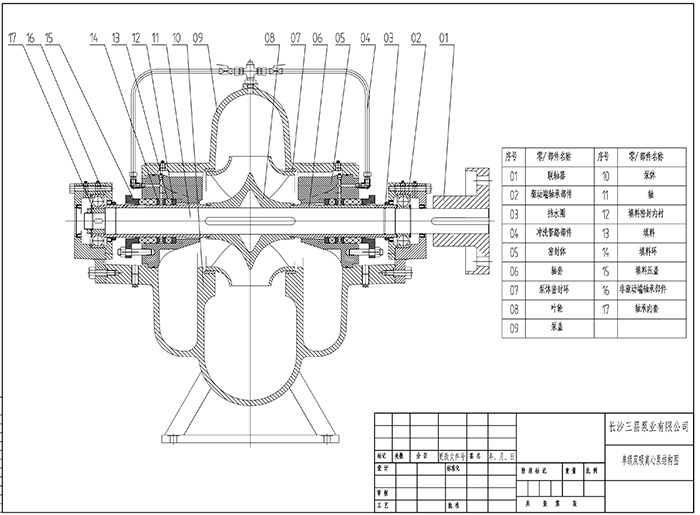
1. For pumps with packing seal: Install the impeller, shaft sleeve, shaft sleeve nut, packing ring, packing, packing gland, water deflector and bearing assembly in sequence. Fit the double-suction wear ring, then mount the coupling.For pumps with mechanical seal: Install the impeller, shaft sleeve, mechanical seal sleeve, rotating ring and stationary ring of mechanical seal, mechanical seal gland and bearing assembly in sequence. Fit the double-suction wear ring, then mount the coupling.
2. Check the radial runout of the outer circle of the impeller sealing part and the shaft sleeve on the rotor assembly.
3. Install the rotor assembly and studs on the pump casing, then fit the bearing housing cover. Adjust the axial position of the impeller to the center of the pump casing flow passage via the shaft sleeve nut and secure it. Fasten the bearing housing cover with set screws.
4. Place the paper gasket on the split surface, install the pump cover, drive in the taper pins, and tighten the pump cover nuts.For packing sealed pumps: Do not over-tighten the packing, which will cause shaft sleeve overheating and increased power consumption. Loose packing will lead to excessive liquid leakage and reduced pump efficiency.After assembly, rotate the pump shaft manually. It shall turn smoothly without friction or collision.Disassembly shall be performed in the reverse order of assembly.
Pump Installation Precautions
1. Inspect the pump and motor to confirm no damage.
2. The total of pump installation height, pipeline head loss and velocity head shall not exceed the allowable suction vacuum height specified in the product datasheet. The foundation dimensions shall conform to the overall layout of the pump unit.
3. Installation Procedures
(1) Fit anchor bolts and nuts on the pump and motor, then place the unit on the concrete foundation with reserved bolt holes. Adjust wedge shims to level the unit and align the pump shaft with the motor shaft. Afterwards, fill all anchor bolt holes with concrete.
(2) After the concrete fully cures, recheck shaft alignment via the outer circle of the two couplings. The total deviation shall not exceed 0.1 mm, and the circumferential unevenness of coupling gap shall be within 0.3 mm. Tighten anchor nuts and re-verify alignment. Fill concrete under the base of pump and motor, while keep clearance around wedge shims.
(3) Confirm the motor rotation direction matches the pump, then install coupling pins.
4. Separate supports shall be arranged for inlet and outlet pipelines. Do not let the pump bear the weight of pipelines.
5. Ensure tight sealing at joints between the pump and pipelines. The suction and discharge pipelines must be airtight to avoid air accumulation.
6. If the pump is installed above the water level, mount a foot valve for priming. Vacuum priming is also acceptable.The above applies to pump units without common base frame. For units equipped with common base frame, follow the same installation rules.
7. A gate valve and a check valve are generally installed on the discharge pipeline (check valve is unnecessary when head is less than 20 m). The check valve shall be mounted behind the gate valve.
Pump Start-up, Shutdown & Operation
1. Start-up and Shutdown
(1) Rotate the pump rotor manually; it shall turn smoothly and freely.
(2) Close the discharge gate valve and fill the pump with water. Use a vacuum pump for priming if no foot valve is installed. Ensure the pump is fully filled with liquid and free of trapped air.
(3) Close the cocks of vacuum gauge and pressure gauge before starting the motor. After the motor runs at rated speed, open the cocks gradually, then slowly open the discharge gate valve. Regulate the flow by adjusting the valve opening.
(4) Tighten the nuts on the packing gland evenly. Allow liquid to drip slightly, and monitor temperature rise of the packing chamber.
(5) First close the cocks of gauges and the discharge gate valve, then cut off motor power. In low-temperature environments, remove the square plug at the pump bottom and drain residual water to prevent freezing and cracking.
(6) For long-term shutdown, disassemble the pump, wipe off water on all parts, and apply anti-rust oil on machined surfaces for storage.
2. Operation Rules
(1) The maximum temperature of pump bearings shall not exceed 75℃.
(2) Calcium-based grease for bearing lubrication shall fill 1/3 ~ 1/2 of the bearing housing. Replace the grease regularly.
(3) Retighten the packing gland appropriately when the packing wears. Replace the packing if worn severely. Mechanical seals feature long service life of about one year under normal operation.
(4) Inspect the flexible coupling periodically and monitor temperature rise of motor bearings.
(5) Stop the pump immediately if abnormal noise or faults occur during operation. Troubleshoot before restarting.
(6) Do not increase the pump operating speed arbitrarily. Speed reduction is permitted.
Customer Case
Send Inquiry
If you are interested in our products, please leave us a message and we will reply to you as soon as possible, thank you!



Hunan Sanchang Pump Co., Ltd.
| Email: | info@sanchangpump.net |
| Hotline: | +86 181 4266 2779 |
| +86 193 1300 1794 | |
| Mobile/Wechat/WhatsApp: | +86 181 4266 2779 |
| Address: | No.517,Xiangfu Road, Yuhua |
| District, Changsha City | |
| Hunan Province, P.R.C |
