
Products
Recommend Products
Contact Us
| Email: | info@sanchangpump.net |
| Hotline: | +86 181 4266 2779 |
| +86 193 1300 1794 | |
|
Wechat: |
+86 181 4266 2779 |
|
WhatsApp: |
+86 181 4266 2779 |
| Address: | No.517,Xiangfu Road |
| Yuhua District, | |
| Changsha City | |
| Hunan Province, P.R.C |

API 610 OH1 Horizontal Single-Stage Centrifugal Pump
Classification:
API 610 Pump
Power Plant
Water Conservancy
Energy-saving Renovation
Key words:
Chemical Pump
Centrifugal Pump
Single-stage Chemical Pump


Hotline:
- Product Description
- Performance Parameters
- Installation Drawings
- Installation and Operation
- Faults and Solutions
-
- Commodity name: API 610 OH1 Horizontal Single-Stage Centrifugal Pump
Flow Range: 6.3~400 m3/h</br> Head Range: 5~125 m</br> Fluid Temperature: -20~150 ℃ (Please specify if higher than 80℃)</br> Inlet Pressure: 0~7.5 MPa (Please specify if higher than 0.4 MPa)</br> Shaft Seal: packing seal, mechanical seal</br> Available Materials: HT200, HT250, QT600, ZG, 304, 316, 316L, 317L, 904L, CD</br></br></br></br>
The OH1 pump is a horizontal, single-stage, single-suction overhung centrifugal pump designed and manufactured in full compliance with the latest API 610 (ISO 13709) industrial standard. Different from OH2 pumps, the OH1 type features afoot-mounted casing with its bearing assembly located between the impeller and the coupling end. This classic API construction delivers exceptional rigidity, mechanical stability, and operational safety for continuous-duty process applications.
OH1 pumps are widely recognized as the most reliable general-purpose process pumps for refineries, petrochemical plants, power stations, and oil & gas facilities, specially engineered for handling high-temperature, slightly corrosive, and clean-to-medium contaminated industrial fluids under steady 24/7 operating conditions.

Application
OH1 API pumps are extensively adopted for stable fluid transportation in heavy-duty industrial fields:
- Petroleum & Refinery: Crude oil transfer, fuel oil circulation, refinery process water, condensate oil, and intermediate fluid delivery
- Petrochemical & Chemical Industry: Mild corrosive medium transfer, solvent circulation, process water, and chemical auxiliary fluid pumping
- Power Generation: Plant cooling water, auxiliary boiler water, condensate recycling, and circulating water systems
- Oil & Gas Field: Well-site process fluid transfer, pipeline boosting, and produced water treatment
- General Industrial Process: Water circulation, medium-temperature fluid delivery, and auxiliary system fluid transportation
Typical Operating Parameters
- Flow range: 3 ~ 1800 m³/h
- Head range: 8 ~ 200 m
- Max working pressure: 10.0 MPa
- Medium temperature: -40℃ ~ +400℃
- Speed: 1450 / 2900 RPM
- Continuous 24-hour operation capability
Material
We provide customizable material combinations to adapt to different temperatures, corrosion levels, and medium characteristics:
- Standard Clean Oil & Water Service
Casing: Cast Iron / WCB Carbon Steel
Impeller: SS304 Stainless Steel
Shaft: 4140 Alloy Steel with Stainless Steel Sleeve - Mild Corrosive & General Petrochemical Service
Casing: WCB Carbon Steel
Impeller: SS316L Stainless Steel
Shaft: 4140 + SS316L Anti-corrosion Sleeve - Medium Corrosive & High-temperature Service
Casing: CF8 / CF8M Cast Stainless Steel
Impeller: 316L / Duplex 2205
Shaft: High-grade stainless steel or duplex steel - Severe Corrosion & Special Process Service
Wetted parts: Duplex Steel 2205 / 2507, CD4MCU, Hastelloy optional
Model Description
Example: COZ (I) 50-315A
COZ -- Chemical Process Pump
50 -- Discharge diameter: 50 mm
315 -- Impeller diameter: 65 mm
A -- Impeller diameter trimming code (A for the first trimming, B for the second trimming)
Structure Features
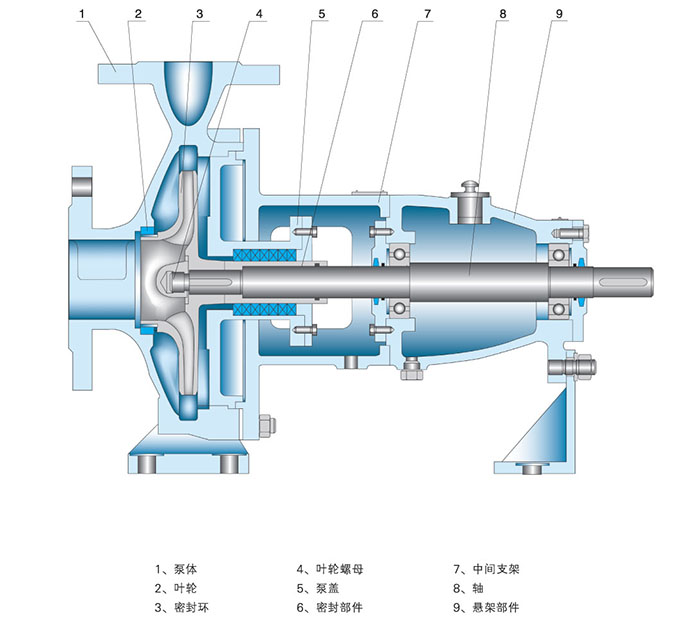
- Classic OH1 API Standard Structure
Foot-mounted radial split casing design, with bearings installed between the impeller and motor coupling. This layout ensures excellent overall mechanical balance, low vibration, and high operational stability during long-term continuous running. - Rugged Integral Pump Casing
Thick-wall casting with standard corrosion allowance, high structural rigidity, and strong resistance to pipeline stress and thermal deformation, fully meeting API 610 heavy-duty requirements. - Optimized Overhung Impeller Design
Back-vane hydraulic balance structure effectively reduces axial thrust, minimizes bearing load, and extends the service life of rotating components. - Standard API Mechanical Seal System
Compatible with full API seal flush plans (Plan 11, 13, 21, 23, 32, 52, 53, 62). Single seal, tandem seal, and double seal configurations are available for flammable, toxic, and high-temperature media to ensure zero leakage operation. - Heavy-Duty Bearing Assembly
Large-size precision rolling bearings with grease or oil lubrication options. Stable support structure guarantees low noise and long service life under high-load working conditions. - Convenient Maintenance
Reasonable structural layout enables quick disassembly and routine maintenance without removing pump piping, greatly reducing equipment downtime and maintenance costs.
Full API 610 Compliance
Equipped with vent ports, drain ports, wear protection parts, anti-rotation devices, and standardized auxiliary cooling & flushing pipelines, fully adapted to harsh industrial process environmentsProduct Strength
- Strictly follows API 610 latest edition for heavy-duty process industry standards
- Superior mechanical stability with low vibration and long continuous operation cycle
- Multiple material solutions for temperature and corrosion adaptability
- Complete API sealing solutions for safe and leakage-free process fluid delivery
- Low maintenance cost, high interchangeability of standard spare parts
- Ideal cost-effective API process pump for general refinery and chemical process services
-
Flow Range: 6.3~400 m3/h
Head Range: 5~125 m
Fluid Temperature: -20~150 ℃ (Please specify if higher than 80℃)
Inlet Pressure: 0~7.5 MPa (Please specify if higher than 0.4 MPa)
Shaft Seal: packing seal, mechanical seal
Available Materials: HT200, HT250, QT600, ZG, 304, 316, 316L, 317L, 904L, CD
-
-
Disassembly and Assembly
1. To inspect or replace the impeller, close the outlet valve, remove flange bolts and base plate bolts, then lift the pump out of the container with lifting equipment.
2. Place the base plate on the support, remove all bolts of the pump casing, take out the pump cover and impeller nut. Tap the pump casing gently with two hammers to detach the impeller.
3. For replacement of rolling bearings or packing, keep the base plate in place. Remove the motor and corresponding brackets first, then take off the pump coupling, gland and round nut, and extract the bearing housing. To replace packing, remove the packing gland before taking out and installing new packing.
4. Assembly shall be performed in the reverse order of disassembly. Ensure the concentricity of all components mounted on the shaft.
Installation, Operation and Maintenance
1. After assembly, turn the coupling manually to check for flexible rotation. Listen for metal friction noise and verify all nuts are fully tightened.
2. Check the concentricity between the pump shaft and motor shaft. The radial runout of the two couplings shall not exceed 0.1 mm, and the end face clearance between them shall be kept at 1~2.5 mm.
3. The distance from the pump suction port to the container bottom shall be 2 to 3 times the suction port diameter. The clearance between the pump casing and container wall shall be more than 2.5 times the port diameter.
4. The discharge pipeline shall be supported by separate brackets. The pipeline weight shall not be borne by the pump.
5. Check the motor rotation direction to ensure the pump runs as marked.
6. Close the gate valve and pressure gauge on the discharge pipeline, and connect the cooling water pipe.
7. Start the motor, turn on the pressure gauge, then slowly open the discharge gate valve to the required position for normal operation.
8. Inspect the pump and motor regularly. The temperature rise of bearings shall not exceed 75℃, and sufficient grease shall be filled in the bearing housing.
-
Pump fails to start
1. Power failure: Check the power switch and circuits.
2. Motor wiring fault: Inspect motor connections.
3. Internal blockage: Check for foreign objects inside the pump.
4. Motor failure: Check if the motor is damaged.
Reduced water output
1. Air leakage in pump chamber: Inspect shaft seals, sealing rings and valves for damage.
2. Air leakage at inlet valve: Check the valve sealing ring for damage.
3. Foreign matter, friction or blockage inside pump chamber: Remove foreign objects and clean deposits inside the pump.
Excessive operating noise
1. Loose connection between pump base and support: Reinstall or replace the support bracket.
2. Poor fitting between pump chamber and pump body: Adjust the axial clearance to ensure tight contact.
3. Damaged bearings or foreign matter ingress: Replace the bearings.
Excessive pump temperature
1. Pump burnout: Inspect the pump for damage and replace defective components.
2. Damaged bearings or inadequate lubrication: Check bearings and lubrication system, replace faulty bearings and maintain proper lubrication.
The above are common faults and corresponding solutions for submerged pumps. Regular maintenance is recommended during operation. Timely troubleshooting shall be performed according to actual conditions to extend the pump service life and ensure production safety.
Customer Case
Send Inquiry
If you are interested in our products, please leave us a message and we will reply to you as soon as possible, thank you!



Hunan Sanchang Pump Co., Ltd.
| Email: | info@sanchangpump.net |
| Hotline: | +86 181 4266 2779 |
| +86 193 1300 1794 | |
| Mobile/Wechat/WhatsApp: | +86 181 4266 2779 |
| Address: | No.517,Xiangfu Road, Yuhua |
| District, Changsha City | |
| Hunan Province, P.R.C |
