
Products
Recommend Products
Contact Us
| Email: | info@sanchangpump.net |
| Hotline: | +86 181 4266 2779 |
| +86 193 1300 1794 | |
|
Wechat: |
+86 181 4266 2779 |
|
WhatsApp: |
+86 181 4266 2779 |
| Address: | No.517,Xiangfu Road |
| Yuhua District, | |
| Changsha City | |
| Hunan Province, P.R.C |

SH Type Single-stage Double-suction Split Case Pump
Classification:
Split Case Centrifugal Pump
Energy-saving Renovation
Petrochemical
Key words:
Split Case Pump
BB1 Pump
Single-stage Double-suction Pump


Hotline:
- Product Description
- Performance Parameters
- Installation Drawings
- Installation and Operation
- Faults and Solutions
-
- Commodity name: SH Type Single-stage Double-suction Split Case Pump
Flow Range: 160~18000 m3/h</br> Head Range: 10~280 m</br> Fluid Temperature: -20~80℃</br> Inlet Pressure: ≤ 0.6 MPa</br> Shaft Seal: packing seal, mechanical seal</br> Available Materials: HT200、HT250、QT600、ZG、304、316、316L、317L、904L、CD4-MCu, etc</br></br></br></br>
S, SH type horizontal single-stage double-suction split case agricultural centrifugal pump is a new-generation high-efficiency and energy-saving pump.
It adopts an upgraded design with a wider application scope than SA and conventional SH models.
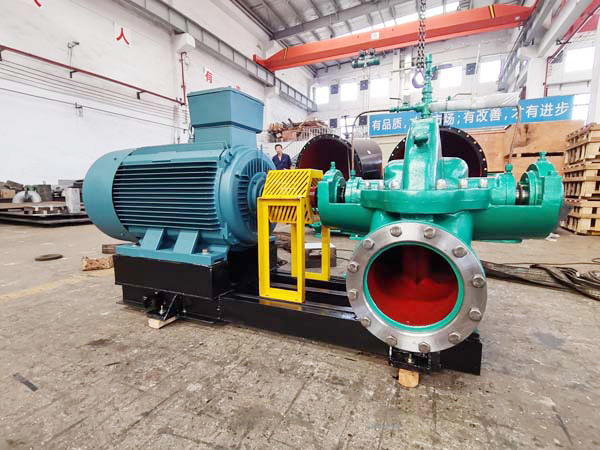
Manufactured in compliance with relevant standards, it features high serialization, standardization and universal interchangeability.
Equipped with innovative structures and optimized materials, the pump delivers advanced performance and stable operation.
It offers high safety and reliability, and is applicable for conveying various media.
I. Application Scope
This pump is suitable for clean water transportation.
It can also convey liquids with physical and chemical properties similar to water.
Main Application Scenarios:
- Urban water supply and drainage
- Water intake and pressurization for power plants
- Industrial process system water pressurization
- Farmland irrigation and drainage
- Water conservancy projects
- Petrochemical projects
II. Structure Description
- Suction and discharge nozzles are installed below the pump shaft.
- Nozzles are horizontally arranged and perpendicular to the shaft axis.
- No pipeline or motor disassembly is needed for maintenance.
- Standard rotation: clockwise viewed from the drive end.
- Counterclockwise rotation is customizable on request.
Main Components: Pump body, pump cover, impeller, pump shaft, double-suction wear ring, shaft sleeve
Component Materials:
- Pump shaft: high-quality carbon steel
- Other major parts: cast iron, cast steel, stainless steel
Pump Body & Pump Cover
- Form a closed working chamber for the impeller
- Flanges reserve tapped holes for vacuum gauges and pressure gauges
- Threaded drain holes are equipped at flange bottoms
Impeller
- Passes professional static balance test
- Fixed on the shaft by bilateral shaft sleeves and lock nuts
- Axial position is adjustable via lock nuts
- Symmetrical double-suction structure fully balances axial thrust
Bearing System
- Radial ball bearings mounted at both pump ends
- Adopts standard grease lubrication
Wear Ring
Effectively reduces liquid leakage from pressure chamber to suction chamber.
Driving Mode
- Standard drive: motor drive via flexible coupling
- Optional drive: internal combustion engine drive
Shaft Seal Structure
- Standard seal: gland packing
- Optional seal: mechanical seal
- Built-in packing ring prevents air ingress
- Cools and lubricates the seal chamber during operation
- High-pressure liquid flows through trapezoidal grooves to form stable water seal
III. Material Description
Multiple optional and customizable materials for different working conditions:
Copper, cast iron, ductile iron, 316 stainless steel, 416 stainless steel, duplex steel, Hastelloy, Monel, titanium alloy, Alloy 20 and more custom materials.
IV. Model Description
Example: 500 S/SH 35A
- 500 -- Pump inlet diameter, 500 mm
- S/SH -- Single-stage double-suction split case clean water centrifugal pump
- 35 -- Design head, 35 m
- A -- First impeller trimming
-
Flow Range: 160~18000 m3/h
Head Range: 10~280 m
Fluid Temperature: -20~80℃
Inlet Pressure: ≤ 0.6 MPa
Shaft Seal: packing seal, mechanical seal
Available Materials: HT200、HT250、QT600、ZG、304、316、316L、317L、904L、CD4-MCu, etc
-

-
Assembly & Disassembly
1. Assembly of Rotor Assembly,mount the impeller, shaft sleeve, shaft sleeve nut, packing sleeve, packing ring, gland packing, water deflector and bearing assembly onto the pump shaft in sequence. Fit the double-suction wear ring, then install the coupling.
2. Place the rotor assembly into the pump body. Adjust the axial position of the impeller to the middle between the double-suction wear rings on both sides and fix it securely. Fasten the bearing housing cover with set screws.
3. Install the packing, place the gasket for the split joint, fit the pump cover and tighten the stud pins, then fasten the pump cover nuts. Finally install the packing gland.Do not overtighten the packing gland. Excessive compression will overheat the shaft sleeve and increase power consumption. Loose packing will cause severe liquid leakage and reduce pump efficiency.
After assembly, rotate the pump shaft by hand. It is qualified if no friction occurs and the rotation is smooth and even. Disassembly shall be performed in the reverse order of assembly.
Installation Inspection
1. Inspect the pump and motor to ensure no damage.
2. The total of pump installation height, hydraulic loss of suction pipeline and velocity head shall not exceed the allowable suction vacuum height specified in the product catalogue. The foundation dimensions shall conform to the mounting dimensions of the pump unit.
3. Installation Procedures
① Place the pump on the concrete foundation pre-embedded with anchor bolts. Level the unit by adjusting wedge shims, and slightly tighten the anchor bolts to prevent displacement.
② Pour concrete between the foundation and pump base.
③ After the concrete fully cures, retighten the anchor bolts and recheck the pump levelness.
④ Align the motor shaft and pump shaft to ensure they are coaxial. The radial runout tolerance of the coupling outer circle is 0.1 mm, and the unevenness tolerance of the end clearance along the circumference is 0.3 mm. Recheck after connecting pipelines and trial operation to meet the above requirements.
⑤ Confirm the rotation direction of the motor matches that of the pump, then install the coupling and connecting pins.
4. Independent supports shall be provided for suction and discharge pipelines. Do not let the pump body bear pipeline load.
5. Ensure airtight connection between the pump and pipelines. The suction pipeline must be completely airtight with no air trapping inside.
6. If the pump is installed above the liquid level, install a foot valve for priming, or adopt vacuum water diversion.
7. A gate valve and a check valve shall be installed on the discharge pipeline (check valve is not required when head is less than 20 m), with the check valve mounted behind the gate valve.The above procedures apply to pump units without common base plate.
For pumps equipped with a common base plate, level the whole unit by adjusting wedge shims between the base plate and concrete foundation, then pour concrete. The installation principles and requirements are the same as those for units without a common base plate.
Pump Start, Stop and Operation
1. Start and Stop
① Before startup, turn the pump rotor manually; the rotation shall be smooth and flexible.
② Close the discharge gate valve, then fill the pump with water. Use a vacuum pump for water diversion if no foot valve is equipped. Ensure the pump is fully filled with water and free of trapped air.
③ If a vacuum gauge or pressure gauge is fitted, close the corresponding stopcock before starting the motor. Open the stopcock after the motor runs at rated speed. Gradually open the discharge gate valve: throttle the valve to reduce flow if overcapacity occurs, and fully open it if the flow is insufficient.
④ Tighten the compression nuts on the packing gland evenly. Keep the liquid dripping slightly, and monitor the temperature rise of the packing chamber.
⑤ To stop the pump: first close the stopcocks of gauges and the discharge gate valve, then cut off the motor power.In low-temperature environments, remove the square plug at the bottom of the pump body and drain all residual water to prevent freezing and cracking.
⑥ For long-term shutdown, disassemble the pump, wipe off water on all components, and apply anti-rust oil on machined surfaces for storage.
2. Operation Rules
① The maximum operating temperature of pump bearings shall not exceed 75°C.
② The calcium-based grease for bearing lubrication shall fill 1/3 ~ 1/2 of the bearing housing cavity.
③ Retighten the packing gland appropriately when the packing wears out. Replace the packing if severely worn.
④ Inspect the coupling regularly and monitor the temperature rise of motor bearings.
⑤ Stop the pump immediately if abnormal noise or faults occur during operation. Identify and eliminate the problem before restarting.
⑥ Do not arbitrarily increase the speed of the water pump But it can be used to reduce the speed If the rated speed of this type of pump is n, the flow rate is Q, the head is H. The shaft power is N, and the speed is reduced to n1. After reducing the speed, the flow rate is reduced Head lift The shaft powers are Q1, H1, and N1, respectively. Their interrelationships The following formula can be used for conversion:
Q1=(n1/n)Q H1=(n1/n)²H N1=(n1/n)³N
Customer Case
Send Inquiry
If you are interested in our products, please leave us a message and we will reply to you as soon as possible, thank you!



Hunan Sanchang Pump Co., Ltd.
| Email: | info@sanchangpump.net |
| Hotline: | +86 181 4266 2779 |
| +86 193 1300 1794 | |
| Mobile/Wechat/WhatsApp: | +86 181 4266 2779 |
| Address: | No.517,Xiangfu Road, Yuhua |
| District, Changsha City | |
| Hunan Province, P.R.C |
