
Products
Recommend Products
Contact Us
| Email: | info@sanchangpump.net |
| Hotline: | +86 181 4266 2779 |
| +86 193 1300 1794 | |
|
Wechat: |
+86 181 4266 2779 |
|
WhatsApp: |
+86 181 4266 2779 |
| Address: | No.517,Xiangfu Road |
| Yuhua District, | |
| Changsha City | |
| Hunan Province, P.R.C |

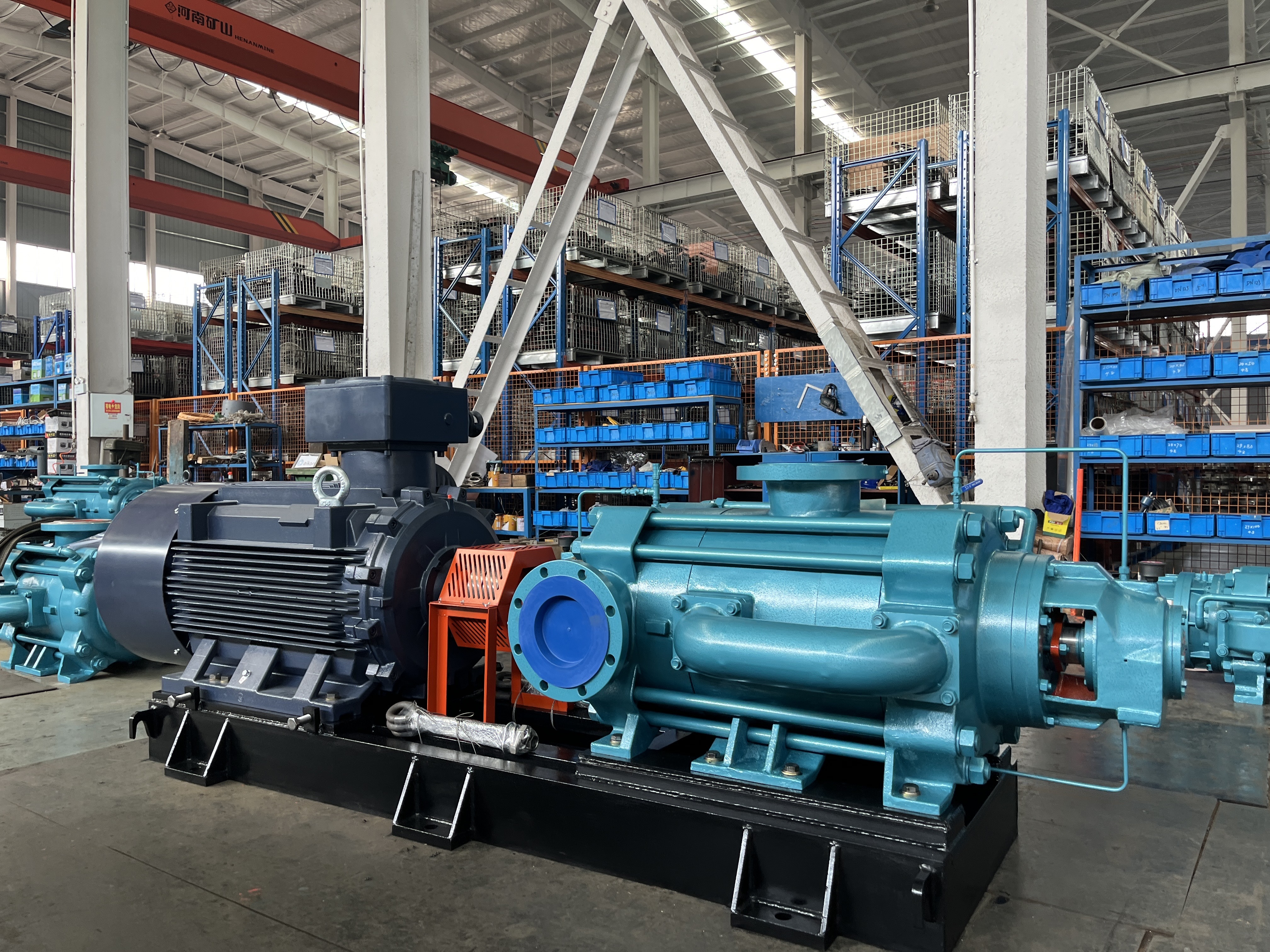
DP Type Horizontal Self-balancing Multistage Centrifugal Pump
Classification:
Multistage Centrifugal Pump
Mining
Petrochemical
Key words:
Centrifugal Pump
BB4 Self-balancing Multistage Pump
Water Pump


Hotline:
- Product Description
- Performance Parameters
- Installation Drawings
- Installation and Operation
- Faults and Solutions
-
- Commodity name: DP Type Horizontal Self-balancing Multistage Centrifugal Pump
Flow Range: 3.75~1400 m3/h</br> Head Range: 50~2000 m</br> Fluid Temperature: 0 ℃ ~ 80 ℃</br> Inlet Pressure: 0.6 MPa</br> Shaft Seal: packing seal, mechanical seal</br> Available Materials: HT200, HT250, QT600, ZG, 304, 316, 316L, 317L, 904L, CD4-MCu, etc</br></br></br>
Developed by our company based on imported advanced technologies after digestion and absorption, D(P) type self-balancing multistage pump features high efficiency, superior anti-cavitation performance as well as stable and reliable operation. It is applicable for coal mines, mineral mines, factories and other sites to convey neutral mine water and similar sewage with solid particle content ≤1.5% (particle size below 0.5 mm) and medium temperature ≤40℃.
Model Description
Example: D280J-43X8(P);
D(P) -- High-efficiency energy-saving self-balancing multistage pump;
280 -- Design rated flow (m3/h);
J -- Mechanical seal (not marked as packing seal);
43 -- Single-stage design head (m);
8 -- Number of pump stages.
Structure and Working Principle of Main Components
1. Main Components
Parts include front suction casing, discharge casing, rear suction casing, diffuser, right diffuser, left/right diffuser for discharge section, middle casing, impeller, opposed impeller, pump shaft, balance drum, front/rear positioning sleeve, adapter bracket and reverse flow channel.
The rotor assembly consists of shaft-mounted impellers, opposed impellers, balance drum, impeller spacer and front/rear positioning sleeves. The drive end is supported by a cylindrical roller bearing, while the non-drive end is equipped with a pair of face-to-face mounted angular contact ball bearings with grease lubrication.
2. Pump Hydraulic Chamber
Formed jointly by front suction casing, rear suction casing, middle casing, diffuser, right diffuser, left/right discharge diffuser, reverse flow channel and discharge casing. Liquid enters axially from one side; axial thrust produced by each pair of symmetrically fitted impellers counteracts mutually for automatic axial force balance. Low-pressure stages are arranged on both ends to reduce pressure load on shaft seals.
3. Sealing & Auxiliary Parts
① Shaft Seal: Standard soft packing seal; packing tightness shall be properly adjusted to permit intermittent droplet leakage.
② Drive Configuration: Direct-driven by electric motor via flexible coupling; pump rotates clockwise when viewed from motor side.
③ Bearing Arrangement: Cylindrical roller bearing at drive end, paired angular contact ball bearings at non-drive end.
④ Wear Ring: Prevents high-pressure medium from leaking back to suction side and is replaceable after abrasion.
⑤ Balance Drum: Installed behind final-stage impeller and rotates with rotor; radial clearance is formed between outer drum surface and inner bore of balance sleeve.
⑥ Front & Rear Positioning Sleeves: Installed beside two stuffing boxes and replaceable upon wear.
4. Working Principle
Driven by the motor, the pump shaft rotates to apply work on conveyed liquid and boost medium energy. The liquid is delivered from suction sump through pump wetted components to designated height or required pressure.
Product Features
1. Trouble-free operation and long overhaul interval. Unique axial thrust balance design plus fixed-floating bearing positioning structure eliminates mechanical friction and collision during service, extending maintenance cycle.
2. High hydraulic efficiency and outstanding energy-saving effect. Advanced sealing structure drastically reduces leakage loss and improves overall pump efficiency.
3. Innovative construction with upgraded technology. Symmetric impeller layout breaks conventional pump structural limits; exclusive throttling & pressure-reducing device and balance structure suit harsh medium conditions.
4. Excellent anti-cavitation property and long service life. Double-suction first-stage impeller delivers superior cavitation resistance for smooth, low-noise running and prolonged service lifespan.
5. Low maintenance cost. Elimination of failure-prone wear-intensive balance disc greatly cuts maintenance expense; upgraded materials and craftsmanship further enhance operational stability and service life.
Structural Description
D(P) series is horizontal self-balancing centrifugal pump with horizontal suction port on suction casing and vertically upward discharge port on discharge casing. Suction casing, middle casings, discharge casing and secondary suction casing are fastened integrally by through tie bolts; pump head can be adjusted by increasing or reducing stage quantity.
1. Main spare parts: suction casing, suction end cover, suction baffle, middle casing, discharge casing, secondary suction casing, diffuser, final-stage diffuser, return diffuser, final-stage return diffuser, impeller, opposed impeller, pump shaft, throttling pressure-reducing unit, spacer sleeve and bearing housing.
2. Hydraulic chamber composed of suction casing, middle casing, discharge casing, secondary suction casing, diffuser, return diffuser and transition pipe.
3. Rotor set includes pump shaft, impeller, opposed impeller, throttling pressure-reducing assembly, bearing spacer and shaft sleeve. Shaft transmits torque to drive impellers. Bearings adopt fixed-floating dry grease lubrication layout: cylindrical roller bearing on drive end, paired angular contact ball bearings on non-drive end.
4. Shaft seal adopts packing seal composed of stuffing box body, packing and packing ring fitted on suction casing. Medium inside stuffing box realizes sealing, cooling and lubrication; sealing water is supplied by internal pumped clean water or external pressurized service water. Replaceable shaft sleeves are installed on both shaft ends to protect pump shaft from abrasion.
-
Flow Range: 3.75~1400 m3/h
Head Range: 50~2000 m
Fluid Temperature: 0 ℃ ~ 80 ℃
Inlet Pressure: 0.6 MPa
Shaft Seal: packing seal, mechanical seal
Available Materials: HT200, HT250, QT600, ZG, 304, 316, 316L, 317L, 904L, CD4-MCu, etc
-
Outline Installation Drawing of DP Horizontal Self-balancing Multistage Centrifugal Pump

-
Installation Instructions for DP Type Horizontal Self-balancing Multistage Centrifugal Pump
Pre-installation Preparation
1. Determine the installation location of the multi-stage pump: the location where the installation is stable and easy to operate, repair and overhaul should be selected.
2. Confirm the location of the water injection port: the water injection port should be set at the inlet pressure pipe and about 20cm away from the pump to avoid backflow and change the impeller speed of the multi-stage pump.
3. Deal with the inlet pressure pipeline: prepare the pipeline and flange connection part to ensure that the connection part is free of foreign matter or rust.
4. Prepare the power supply and cables: select the appropriate cable according to the power requirements of the multi-stage pump, and ensure that the cable quality is good.
Installation Procedures
1. Assemble the components: Assemble the components according to the requirements of the instructions or drawings, and determine the positions of the drain, vent, and lubrication parts.
2. Install the multi-stage pump: place the multi-stage pump in the installation position, pay attention to the smooth contact between the base of the multi-stage pump and the ground, and the seat surface of the base is perpendicular to the ground.
3. Interface connection: connect the inlet pressure pipe and the outlet pressure pipe. The connecting flange shall be parallel and horizontal without distortion and deformation.
4. cable wiring: according to the multi-stage pump electrical connection diagram wiring, pay attention to the standardization of wiring and reasonable wiring.
5. Water injection and drainage: open the stop valve of the inlet pressure pipe of the multi-stage pump, and introduce clean water (or including the added pump irrigation and drainage liquid) into the pump to avoid abnormal noise caused by pump vibration.
6. Adjust the pump: adjust the frequency converter or on-demand reducer to ensure that the motor of the multi-stage pump works normally and the water flow speed is moderate.
Post-installation Inspection
1. Check the overall installation of the pump: to ensure that the base of the multi-stage pump is stable and vertical.
2. Check the connection of each pipeline: confirm whether each interface is tightly connected and whether there are abnormal conditions such as abnormal noise.
3. Pump movement test: turn on the power, check whether the motor rotation is stable, whether the sound is normal, whether the pump is leaking, etc.
4. System pressure test: In the experiment, the intelligent instrument records data such as the opening and closing state of the control valve and the water flow. During the test, pay attention to whether there are abnormal conditions such as noise, vibration or high temperature around the system, and deal with any abnormalities in time.
5. Check the wires: Confirm whether the wires are correctly wired and free of damage and other relevant details meet the installation specifications.
The above is a detailed explanation of the installation steps of the multi-stage pump. I hope readers can install the multi-stage pump correctly according to the above steps to ensure that the installed multi-stage pump can operate normally and provide better protection for production and life.
-
Fault one: multi-stage pump does not absorb water pressure gauge and vacuum gauge pointer beating violently
Cause: 1. Insufficient water injection and diversion 2. Air leakage at the connection between pipeline and instrument 3. Excessive suction
Solution: 1. Check whether the bottom valve leaks. 3. Lower the suction height
Fault two: multi-stage pump does not absorb water vacuum table indicates a high degree of vacuum
Reason: 1. The bottom valve is not opened or blocked 2. The resistance of the suction pipeline is too large 3. The filter is blocked
Solution: 1. Check the bottom valve 2. Replace the water absorption 3. Clean the filter
Fault three: pressure gauge pressure but still not out of water
Reason: 1. The resistance of the outlet pipe is too large 2. The rotation direction is wrong 3. The outlet pipe valve is not open 4. The impeller is blocked
Solution: 1. Check or short water pipe 2. Check the motor. Two-phase intermodulation 3. Open the outlet valve 4. Remove the dirt in the impeller
Fault four: can not reach the design flow
Reason: 1. air inhalation 2. due to the lowering of the water level. The submerged depth is not enough. 3. The impeller is blocked by foreign matter. 4. The rotor is severely worn.
Solution: 1. Check the air leakage site and exclude 2. Extend the suction pipe. Deepen the flooding depth 3. Remove and remove foreign objects 4. Replace the sealing ring
Fault five: multi-stage pump power consumption is too large
Reason: 1. Packing is too tight. And heat 2. The flow is too large 3. The rotating body and the shell rub 4. The pump bearing is worn 5. The pump shaft is bent.
Solution: 1. Relax the packing pressure appropriately 2. Close the gate valve opening 3. Trim the position of the rotary body and the shell 4. Replace the bearing 5. Replace or correct
Fault six: multi-stage pump vibration increased
Reason: 1. The impeller is partially blocked 2. The impeller is damaged 3. The flow rate is too small 4. The pump shaft is not concentric with the motor 5. The bearing is damaged 6. Air is mixed. Cavitation occurs
Solution: 1. Disassemble and remove foreign matter 2. Replace the impeller 3. Slightly open the outlet valve 4. Point aligning 5. Change the suction position. Improved water absorption
Customer Case
Send Inquiry
If you are interested in our products, please leave us a message and we will reply to you as soon as possible, thank you!



Hunan Sanchang Pump Co., Ltd.
| Email: | info@sanchangpump.net |
| Hotline: | +86 181 4266 2779 |
| +86 193 1300 1794 | |
| Mobile/Wechat/WhatsApp: | +86 181 4266 2779 |
| Address: | No.517,Xiangfu Road, Yuhua |
| District, Changsha City | |
| Hunan Province, P.R.C |
