
Products
Recommend Products
Contact Us
| Email: | info@sanchangpump.net |
| Hotline: | +86 181 4266 2779 |
| +86 193 1300 1794 | |
|
Wechat: |
+86 181 4266 2779 |
|
WhatsApp: |
+86 181 4266 2779 |
| Address: | No.517,Xiangfu Road |
| Yuhua District, | |
| Changsha City | |
| Hunan Province, P.R.C |

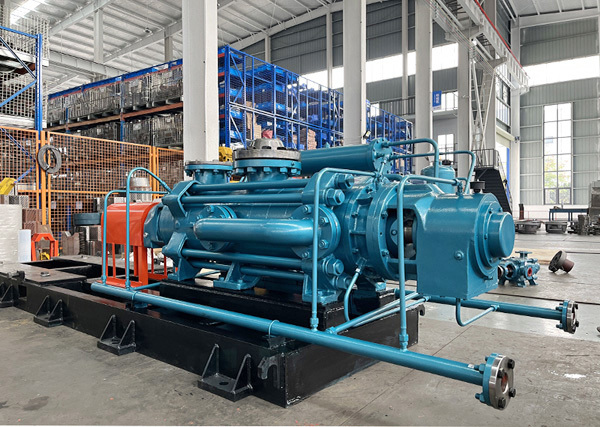
Self-balancing Multistage Boiler Feed Water Pump
Classification:
Multistage Centrifugal Pump
Salt Chemical
Water Conservancy
Key words:
Boiler Feed Water Pump
Centrifugal Pump
Self-balancing Multistage Pump
Head Range: 50~2000 m
Fluid Temperature: -20 ℃ ~ 150 ℃
Inlet Pressure: 0.6 MPa
Shaft Seal: packing seal, mechanical seal
Available Materials: HT200, HT250, QT600, ZG, 304, 316, 316L, 317L, 904L, CD4-MCu, etc
Note: The listed performance parameters are in the normal temperature and clean water state.


Hotline:
- Product Description
- Performance Parameters
- Installation Drawings
- Installation and Operation
- Faults and Solutions
-
- Commodity name: Self-balancing Multistage Boiler Feed Water Pump
Flow Range: 3.75~1400 m3/h<br> Head Range: 50~2000 m<br> Fluid Temperature: -20 ℃ ~ 150 ℃<br> Inlet Pressure: 0.6 MPa<br> Shaft Seal: packing seal, mechanical seal<br> Available Materials: HT200, HT250, QT600, ZG, 304, 316, 316L, 317L, 904L, CD4-MCu, etc<br> Note: The listed performance parameters are in the normal temperature and clean water state.
Product Description
DGP type self-balancing multistage boiler feed pump is designed to deliver clean water free of solid particles, or fluids with similar physicochemical properties, applicable for low, medium and high-pressure boiler water supply service.
Overview
Developed as an advanced high-efficiency, energy-saving and long-service-life multistage centrifugal pump, satisfy customer requirements, the DGP type pump adopts internationally proven high-efficiency energy-saving hydraulic profiles. It abandons the conventional design with balance assemblies, and promotes technical advancement of high-pressure multistage pump products. Designed and manufactured in accordance with API610 specifications, the pump holds a leading technical position across the industry. It features a wide high-efficiency operating range, broad performance envelope, excellent anti-cavitation capability, stable and secure operation, low noise, fewer wearing parts as well as easy installation and maintenance.
Structure Description
The DGP self-balancing multistage boiler feed pump features innovative structural redesign, by removing the conventional axial thrust balancing mechanism, and balance disc assembly used on traditional multistage centrifugal pumps, making it an ideal upgraded replacement for D and DG series multistage centrifugal pumps.
The balancing unit can be eliminated.This eliminates two types of losses: disc friction loss generated by the balance disc, and backflow loss of the balancing medium.As a result, the pump’s hydraulic efficiency rises by 5% to 14%, compared with equivalent conventional multistage pumps. The absence of balance disc friction cuts shaft power input, and achieves remarkable energy conservation, reducing power consumption, by roughly 3% versus similar pump models. In addition, this design fundamentally eliminates typical faults triggered by failed balancing devices, such as severe wear of balance disc/balance ring, and rotor seizure. Service life is significantly extended; its mean trouble-free runtime exceeds three times that of standard pumps, greatly cutting users’ maintenance expenditure and overall life-cycle cost. Years of field operation verify its performance has reached the advanced standard of comparable international products.
Application
By altering pump material and structure, changing seal configuration or adding a cooling system, the pump can also handle hot water, oil products, corrosive media or abrasive-containing fluids up to 185℃.
Model Explanation
Example: DG280J-43X8PDGP -- High-efficiency self-balancing multistage boiler feed water pump280 -- Design flow rate (m³/h)J -- Mechanical seal (unmarked indicates packing gland seal)43 -- Single-stage design head (m)8 -- Number of pump stagesPerformance Features
1. High Efficiency & Energy Saving
Adopting self-developed advanced hydraulic profiles, the pump delivers high-efficiency and energy-saving performance. It is free from balance disc abrasion and rotor axial pulsation, so the impellers maintain optimum concentricity with diffusers. Conventional multistage pumps see obvious efficiency drops from balance disc wear, and forward shift of rotor assemblies, but this design eliminates balancing medium leakage, and cuts volumetric loss. Overall operational efficiency is lifted while shaft power consumption is reduced, and the unit achieves an average efficiency gain of 2%~3% compared with standard multistage pumps.
2. Innovative Structure
The rotor assembly features symmetrically arranged impellers. The axial thrust generated by each pair of impellers counteracts each other. This automatically balances the large internal axial thrust inside the pump casing without balance discs, breaking through the structural limitations of conventional multistage pumps.
3. Unique Technical Design
Equipped with proprietary throttling and pressure-reducing devices plus odd-stage balancing structures, which also serve as auxiliary rotor supports.
4. Superior Operational Reliability
Symmetric impeller layout achieves fundamental self-balancing of operational axial thrust. It removes the high-failure-prone balance disc with narrow clearance, high pressure drop, erosion and abrasion risks.Adverse impacts of axial load on component wear and system disturbance are minimized.Remaining residual axial thrust is absorbed by thrust bearings. It keeps the pump shaft under consistent tension, with even stress distribution and sharply reduced peak stress.This improves rotor rigidity and critical speed, greatly boosting running stability and reliability.
5. Excellent Anti-cavitation Performance & Extended Service Life
Optimized hydraulic and structural design, precision casting and premium wear-resistant materials are adopted. Certain variants employ double-suction first-stage impellers for outstanding cavitation resistance, enabling smooth low-noise operation and prolonged service life.
6. Improved Mechanical Seal Reliability
No axial endplay occurs on rotor parts during startup or shutdown, and no axial pulsation exists in normal operation, resolving the long-standing poor reliability issue of mechanical seals commonly seen on traditional multistage pumps.
7. Wide Application Scope
Without narrow-clearance balance disc assemblies, the pump is applicable for harsher service media than conventional multistage products.
8. Low Maintenance Cost
Precision casting reduces the number of wearing parts and overhaul disassembly frequency. It extends service life, avoids faults from frequent repeated disassembly and cuts overall maintenance expenses.
9. Easy Overhaul
The pump is developed via 3D design with CNC-machined rotors to guarantee strict dimensional tolerance and precision. Thanks to accurate positioning, ordinary technicians can complete assembly following general assembly drawings. It eliminates the need for specialized staff to adjust rotor axial float as required on old-type multistage pumps, brings great convenience to users.
-
Flow Range: 3.75~1400 m3/h
Head Range: 50~2000 m
Fluid Temperature: -20 ℃ ~ 150 ℃
Inlet Pressure: 0.6 MPa
Shaft Seal: packing seal, mechanical seal
Available Materials: HT200, HT250, QT600, ZG, 304, 316, 316L, 317L, 904L, CD4-MCu, etc
Note: The listed performance parameters are in the normal temperature and clean water state.
-
Outline Installation Drawing of DGP Self-balancing Multistage Boiler Feed Water Pump

-
Pre-installation Preparation
1. Determine the installation location of the multi-stage pump: the location where the installation is stable and easy to operate, repair and overhaul should be selected.
2. Confirm the location of the water injection port: the water injection port should be set at the inlet pressure pipe and about 20cm away from the pump to avoid backflow and change the impeller speed of the multi-stage pump.
3. Deal with the inlet pressure pipeline: prepare the pipeline and flange connection part to ensure that the connection part is free of foreign matter or rust.
4. Prepare the power supply and cables: select the appropriate cable according to the power requirements of the multi-stage pump, and ensure that the cable quality is good.
Installation Procedures
1. Assemble the components: Assemble the components according to the requirements of the instructions or drawings, and determine the positions of the drain, vent, and lubrication parts.
2. Install the multi-stage pump: place the multi-stage pump in the installation position, pay attention to the smooth contact between the base of the multi-stage pump and the ground, and the seat surface of the base is perpendicular to the ground.
3. Interface connection: connect the inlet pressure pipe and the outlet pressure pipe. The connecting flange shall be parallel and horizontal without distortion and deformation.
4. cable wiring: according to the multi-stage pump electrical connection diagram wiring, pay attention to the standardization of wiring and reasonable wiring.
5. Water injection and drainage: open the stop valve of the inlet pressure pipe of the multi-stage pump, and introduce clean water (or including the added pump irrigation and drainage liquid) into the pump to avoid abnormal noise caused by pump vibration.
6. Adjust the pump: adjust the frequency converter or on-demand reducer to ensure that the motor of the multi-stage pump works normally and the water flow speed is moderate.
Post-installation Inspection
1. Check the overall installation of the pump: to ensure that the base of the multi-stage pump is stable and vertical.
2. Check the connection of each pipeline: confirm whether each interface is tightly connected and whether there are abnormal conditions such as abnormal noise.
3. Pump movement test: turn on the power, check whether the motor rotation is stable, whether the sound is normal, whether the pump is leaking, etc.
4. System pressure test: In the experiment, the intelligent instrument records data such as the opening and closing state of the control valve and the water flow. During the test, pay attention to whether there are abnormal conditions such as noise, vibration or high temperature around the system, and deal with any abnormalities in time.
5. Check the wires: Confirm whether the wires are correctly wired and free of damage and other relevant details meet the installation specifications.
The above is a detailed explanation of the installation steps of the multi-stage pump. I hope readers can install the multi-stage pump correctly according to the above steps to ensure that the installed multi-stage pump can operate normally and provide better protection for production and life.
-
Common Faults & Troubleshooting of DGP Self-balancing Multistage Boiler Feed Water Pump
Fault 1: Pump fails to prime; violent fluctuation of pressure gauge and vacuum gauge pointers
Causes:
1. Insufficient priming water filled
2. Air leakage at connecting joints of pipeline and instruments
3. Excessive suction lift
Solutions:
1. Check foot valve for leakage and refill priming water fully
2. Fasten leaking connections
3. Reduce suction lift
Fault 2: No water suction; vacuum gauge shows ultra-high vacuum reading
Causes:
1. Foot valve closed or clogged
2. Excessive resistance on suction pipeline
3. Suction strainer blocked
Solutions:
1. Inspect and repair foot valve
2. Modify suction pipeline
3. Clean up the strainer
Fault 3: Pressure gauge reads pressure yet no water discharge
Causes:
1. Overhigh resistance on discharge pipeline
2. Wrong motor rotation direction
3. Discharge gate valve remains closed
4. Impeller clogged with debris
Solutions:
1. Inspect or shorten discharge pipeline
2. Check motor and swap any two power phases to reverse rotation
3. Open discharge gate valve
4. Remove dirt inside impeller
Fault 4: Actual flow rate lower than design value
Causes:
1. Air ingress into pump casing
2. Reduced liquid level leading to insufficient submergence depth
3. Foreign matter blocking impeller passage
4. Severe abrasion of rotary components
Solutions:
1. Locate and eliminate air leakage points
2. Extend suction pipe to increase submergence depth
3. Dismantle pump and remove blockages
4. Replace wear rings
Fault 5: Excessive power consumption of pump unit
Causes:
1. Over-tightened packing with overheating
2. Excessive operating flow
3. Rubbing contact between rotating parts and pump casing
4. Worn pump bearings
5. Bent pump shaft
Solutions:
1. Loosen packing gland appropriately
2. Throttle discharge gate valve to reduce flow
3. Realign rotating assembly and casing
4. Replace defective bearings
5. Straighten or replace bent pump shaft
Fault 6: Abnormally high pump vibration
Causes:
1. Partial blockage inside impeller
2. Damaged impeller
3. Undersize operating flow
4. Misalignment between pump shaft and motor shaft
5. Broken bearings
6. Air entrainment resulting in cavitation
Solutions:
1. Disassemble pump and clear obstructions
2. Install new impeller
3. Slightly open discharge valve to raise flow
4. Perform precise shaft alignment
5. Adjust suction layout to improve suction condition
Customer Case
Send Inquiry
If you are interested in our products, please leave us a message and we will reply to you as soon as possible, thank you!



Hunan Sanchang Pump Co., Ltd.
| Email: | info@sanchangpump.net |
| Hotline: | +86 181 4266 2779 |
| +86 193 1300 1794 | |
| Mobile/Wechat/WhatsApp: | +86 181 4266 2779 |
| Address: | No.517,Xiangfu Road, Yuhua |
| District, Changsha City | |
| Hunan Province, P.R.C |
