
The working principle and structure of a pipeline pump.
Category: Pump Knowledge
2024-10-23
Pipeline Pumpis a commonly used fluid transportation device, widely applied in various industrial, commercial, and household scenarios. Its working principle and structural characteristics allow it to be directly installed in pipelines, thereby simplifying processes and saving space.
I. Working Principle
The working principle of a pipeline pump is mainly based on the centrifugal force generated by the rotation of the impeller. When the pump starts, the impeller rotates under the drive of the motor, causing the liquid inside the pump body to flow towards the outlet due to centrifugal force. A pressure difference is formed during the liquid's intake and discharge process at the impeller, thus achieving continuous liquid transportation. The performance parameters of the pipeline pump, such as flow rate and lift, are closely related to the impeller's rotational speed and the pump's structural design.
II. Structural Characteristics
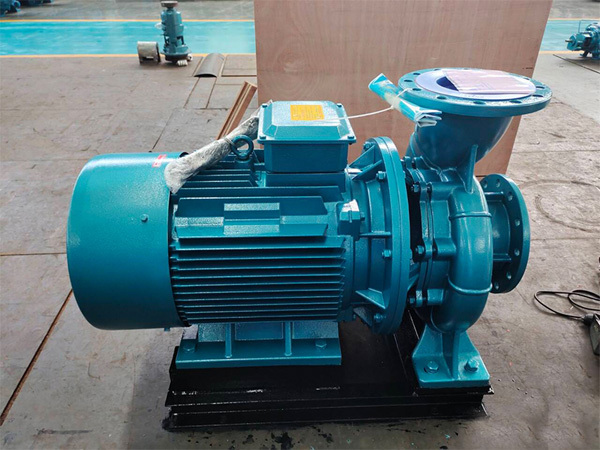
The structure of a pipeline pump typically consists of the pump body, motor, impeller, and sealing device. The pump body is the basic component of the pipeline pump, usually made of metal materials. Its shape can be cylindrical or square, depending on the specific application scenario. There is a groove inside the pump body where the impeller is installed. The motor is the power source that drives the rotation of the pump body and impeller, connected to the pump body via a shaft. The impeller is the core component of the pipeline pump, usually made of metal materials. Its shape resembles a disc with blades, and through the motor's drive, the impeller rotates at high speed, generating centrifugal force and pressure difference. The sealing device is used to prevent liquid or gas from leaking from the pump body, ensuring the normal operation of the pump.
The structure of the pipeline pump is compact and mainly consists of the following parts:
1. Pump Body: The pump body is the main part of the pipeline pump, usually made of cast iron, stainless steel, or other materials, with good corrosion resistance and wear resistance. The interior of the pump body is designed with flow channels to allow smooth passage of the liquid.
2. Impeller: The impeller is the core component of the pipeline pump, composed of multiple blades and a hub. The design and material selection of the impeller have a significant impact on the pump's performance.
3. Shaft and Bearings: The shaft is the key component connecting the motor and the impeller, while the bearings support the movement of the shaft. To ensure smooth operation, the bearings are usually made of materials with good wear resistance.
4. Sealing Device: To prevent liquid leakage, the pipeline pump is equipped with sealing devices, such as mechanical seals or packing seals.
5. Inlet and Outlet Flanges: The inlet and outlet of the pipeline pump are connected to the pipeline, usually using flanged connections for easy installation and maintenance.
6. Drive Part: The pipeline pump is usually driven by an electric motor, although some use diesel or other power sources.
Compared to other types of pumps, pipeline pumps have advantages such as compact structure, easy installation, and stable flow. However, their performance is also affected by factors such as liquid properties, working environment, and usage conditions. Therefore, when selecting and using pipeline pumps, comprehensive consideration based on actual conditions is necessary.
The working principle and structure of pipeline pumps make them indispensable equipment in the industrial field. By utilizing pressure differences, pipeline pumps can push liquids or gases from low-pressure areas to high-pressure areas, achieving medium transportation. The pump body, motor, impeller, and sealing device are the basic components of the pipeline pump, working together to complete the task. Pipeline pumps play an important role in industries such as petroleum, chemical engineering, and water treatment, ensuring the smooth progress of production processes.
In summary, the working principle of pipeline pumps is based on the action of centrifugal force, and their structure is compact and easy to install. Understanding the working principle and structural characteristics of pipeline pumps helps in better selection and use of this equipment, thereby improving the efficiency of fluid transportation.
RELATED INFORMATION
Recommend Products
Contact Us
Free Hotline:+86 18142662779
Fixed telephone:+86 19313001794
Mobile:+86 18142662779(WeChat/WhatsAPP)
E-mail:info@sanchangpump.net




Hunan Sanchang Pump Co., Ltd.
| Email: | info@sanchangpump.net |
| Hotline: | +86 181 4266 2779 |
| +86 193 1300 1794 | |
| Mobile/Wechat/WhatsApp: | +86 181 4266 2779 |
| Address: | No.517,Xiangfu Road, Yuhua |
| District, Changsha City | |
| Hunan Province, P.R.C |
