
Self-balancing multi-stage pump and old-fashioned multi-stage pump comparison advantages and disadvantages
Category: Pump Knowledge
2024-04-16
self-balancing multistage pumpCompared with the old multi-stage pump has more advantages, it has the characteristics of automatic balance, high efficiency, stability, reliability and durability, and can provide better water pressure delivery solutions for the industrial field. With the progress of science and technology and the continuous improvement of the process, it is believed that the self balancing multi-stage pump will be more widely used and popularized in the future.
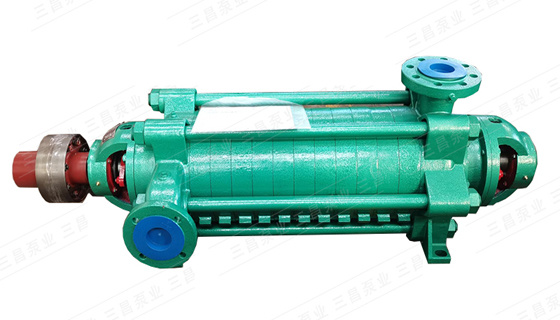
How do you say, if the advantages and disadvantages of self-balancing multi-stage pumps and old-fashioned multi-stage pumps are compared, for example, it is not very rigorous, just like the current fuel vehicles and new energy. New energy has great advantages in daily maintenance and energy saving. The maintenance period is long and cheap, and the most important thing is to save money by using electricity. However, once the electric vehicle has a problem and needs to be overhauled, there, the fuel car is not so picky, just go to a reliable street repair shop.
What kind of car to drive (what kind of water pump to use) needs to be combined with its own actual needs, and cannot be generalized. Before answering this question, we must first reach a consensus, which is also the premise of analyzing the problem: the so-called advantages and disadvantages are all relative. Then, Hunan Sanchang Pump Industry Co., Ltd. will simply analyze the advantages and disadvantages of self-balancing multistage pumps from the most common and customer-focused dimensions.
1. maintenance
1, daily maintenance, self-balancing multi-stage pump is superior
Daily maintenance, mainly to replace the packing or mechanical seal.
Due to the axial force of the old-fashioned multi-stage pump, the pump has an axial movement of 3-5mm during operation. When the rotor travels back and forth during operation, the rotor cannot be positioned, and the spring of the mechanical seal cannot be returned in time, resulting in the service life of the machine seal. Short. The same is true for fillers.
Therefore, in the daily maintenance of this piece, self-balance is dominant.
2, overhaul difficulty, the old multi-stage pump is dominant
When the pump has been running for many years and needs to be dismantled and overhauled, the situation is different. Self-balancing multi-stage pump is more complicated than ordinary multi-stage pump in structure. Under normal circumstances, even if the user unit has a maintenance team, it does not have the ability to dismantle and overhaul, which is what we often say: dismantle it and install it. Can't go up. Therefore, it must be returned to the factory for maintenance.
The traditional multi-stage pump overhaul is relatively simple, its structure is simpler than self-balancing, and the overall difficulty of disassembly and assembly is lower than self-balancing. Therefore, from this level, the difficulty of disassembly is the disadvantage of the self-balancing multi-stage pump, or the disadvantage of the self-balancing multi-stage pump.
3, maintenance frequency, self-balancing multi-stage pump is superior.
Self-balancing multi-stage pump itself water model and structural advantages, decided in the maintenance cycle (maintenance or overhaul) is better than the old-fashioned multi-stage pump, which is what we often say: not easy to bad. If the water quality is better, it can reach 8000 hours of stable operation.
The self-balancing multistage pump has better reliability and durability. Due to its carefully designed and optimized structure, the self-balancing multi-stage pump is more stable in operation and can maintain high performance for a longer time. Old-fashioned multi-stage pumps often require frequent maintenance and replacement, increasing equipment downtime and maintenance costs.
2. energy efficiency issues
We all know that self-balancing multistage pumps are more efficient and energy-saving.
However, this high efficiency is a prerequisite, that is, compared with the traditional D-type multistage centrifugal pump (hereinafter referred to as the old multistage pump), the self-balancing multistage is 2%-10% higher in efficiency because of its own structural advantages. And this is not absolute, if the production of self-balancing manufacturers of the process or process is not rigorous, or the quality of castings, such as rough flow, cracks, sand holes, etc., the final production of products in the energy efficiency utilization may not be as good as the old multi-stage pump.
In addition, for another example, the efficiency of the self-balancing multistage pump is obviously lower than that of the plunger pump under the same working conditions and process head. Although the efficiency of the plunger pump is very high, the shortcomings are also obvious. The maintenance cycle is too short, which is a loss for enterprises that need continuous production, and it is even more uncomfortable for the front-line mechanic of the enterprise.
3. stability
The self-balancing multistage pump adopts an advanced design principle and can realize automatic balancing through its own designed structure. The old multi-stage pump needs to rely on external adjustment to achieve balance. This means that when using self-balancing multistage pumps, there is no need for frequent manual adjustment and maintenance, which greatly saves labor and time costs.
The self-balancing multi-stage pump has higher efficiency and more stable performance during operation. Due to its self-balancing characteristics, self-balancing multi-stage pumps can more effectively reduce the friction loss and energy loss of the pump. In contrast, old-fashioned multi-stage pumps are prone to imbalance during operation, resulting in reduced energy efficiency and increased energy consumption.
RELATED INFORMATION
Recommend Products
Contact Us
Free Hotline:+86 18142662779
Fixed telephone:+86 19313001794
Mobile:+86 18142662779(WeChat/WhatsAPP)
E-mail:info@sanchangpump.net




Hunan Sanchang Pump Co., Ltd.
| Email: | info@sanchangpump.net |
| Hotline: | +86 181 4266 2779 |
| +86 193 1300 1794 | |
| Mobile/Wechat/WhatsApp: | +86 181 4266 2779 |
| Address: | No.517,Xiangfu Road, Yuhua |
| District, Changsha City | |
| Hunan Province, P.R.C |
