
The working principle and structure of seawater desalination pumps.
Category: Pump Knowledge
2024-10-26
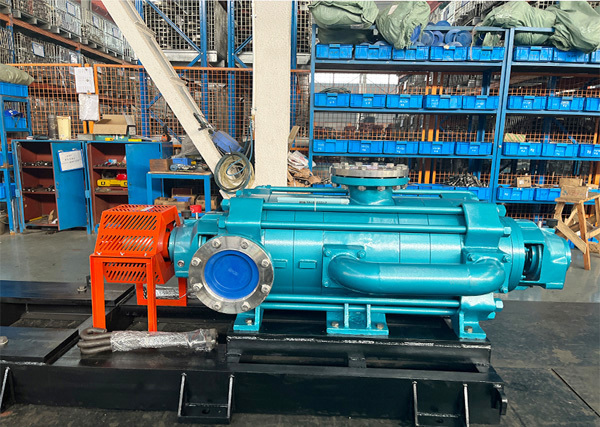
Seawater Desalination PumpIt is a device that can convert seawater into freshwater. It adopts advanced working principles and structures, featuring efficiency and reliability. The seawater desalination pump mainly consists of an inlet, pressure boosting equipment, membrane components, and an outlet.
I. Working Principle of Seawater Desalination Pump
The working principle of the seawater desalination pump utilizes reverse osmosis membrane technology to separate salts and impurities from seawater, thereby obtaining freshwater. First, seawater enters the pressure boosting equipment through the inlet, where the pressure boosting equipment increases the pressure of the seawater, allowing it to pass through the filtration membrane. Then, the pre-treated seawater enters the membrane component, where the reverse osmosis membrane has a microporous structure that prevents the passage of salts and other solutes, allowing only water molecules to pass through. In this way, the salts and impurities in the seawater are retained in the membrane component, while freshwater flows out through the membrane component. Finally, the outlet discharges the concentrated liquid of salts and impurities from the system.
The seawater desalination pump is one of the core devices in seawater desalination systems, primarily responsible for drawing seawater from high-salinity environments and pressurizing it for subsequent treatment units. Its working principle can be divided into the following steps:
1. Suction process: The pump's inlet is connected to the seawater source, creating negative pressure through the rotation of the pump impeller, which draws seawater into the pump.
2. Pressurization process: After entering the pump chamber, the high-speed rotation of the impeller applies pressure to the seawater, providing enough energy to overcome pipeline resistance and pressure loss in subsequent treatment units.
3. Delivery process: The pressurized seawater is sent to the next treatment unit, such as reverse osmosis membranes or distillers, through the pump outlet pipeline.
II. Structure of Seawater Desalination Pump
The structural design of the seawater desalination pump is sophisticated. The membrane component is usually made up of multiple layers of membranes stacked together to enhance the separation effect. The pressure boosting equipment typically uses high-pressure pumps or piezoelectric pumps, which can provide sufficient pressure to ensure seawater passes through the membrane component. The design of the inlet and outlet is reasonable, effectively controlling the inflow and outflow of seawater and the discharge of impurities, ensuring the normal operation of the system. The structural design of the seawater desalination pump is aimed at meeting the requirements for long-term stable operation in high-salinity and highly corrosive environments. Its main structures include:
1. Pump body: Usually made of stainless steel, capable of withstanding corrosion in high-salinity environments. The pump body has an inlet and outlet, as well as a chamber for installing the impeller.
2. Impeller: The core component of the pump, usually made of high-strength, corrosion-resistant materials. The high-speed rotation of the impeller generates centrifugal force, providing pressure to the seawater.
3. Shaft and bearings: The shaft connects the motor to the impeller, responsible for transmitting power. The bearings support the shaft, ensuring smooth rotation.
4. Sealing device: Prevents seawater leakage and external environmental corrosion of the pump's interior. Common sealing forms include mechanical seals and packing seals.
5. Inlet and outlet pipelines: Connect the pump to the seawater source and subsequent treatment units, ensuring smooth transportation of seawater.
6. Drive device: Usually an electric motor that provides power to the pump.
In addition, the seawater desalination pump may also include other auxiliary components, such as cooling systems and lubrication systems, to ensure stable operation in high-salinity and high-temperature environments.
The seawater desalination pump can convert seawater into freshwater by utilizing reverse osmosis membrane technology. Its working principle is straightforward, and its structural design is reasonable, providing a feasible solution to the problem of freshwater resource scarcity. The widespread application of seawater desalination pumps will bring more convenience and development opportunities to people's lives and industrial production.
In summary, the seawater desalination pump, through its unique working principle and structural design, achieves the extraction and pressurization of high-salinity seawater, providing the necessary power for subsequent seawater desalination treatment. Its structural design and material selection are aimed at meeting the requirements for long-term stable operation in high-salinity and highly corrosive environments.
RELATED INFORMATION
Recommend Products
Contact Us
Free Hotline:+86 18142662779
Fixed telephone:+86 19313001794
Mobile:+86 18142662779(WeChat/WhatsAPP)
E-mail:info@sanchangpump.net




Hunan Sanchang Pump Co., Ltd.
| Email: | info@sanchangpump.net |
| Hotline: | +86 181 4266 2779 |
| +86 193 1300 1794 | |
| Mobile/Wechat/WhatsApp: | +86 181 4266 2779 |
| Address: | No.517,Xiangfu Road, Yuhua |
| District, Changsha City | |
| Hunan Province, P.R.C |
